
Cortex for ChatGPT
Give ChatGPT the project knowledge you want it to use. Cortex keeps that knowledge available across conversations and your connected coding agents.
Knowledge in Cortex
Your project requirements
Your team’s standards
The reasons behind each decision

ChatGPT
Knowledge available before the next action
Use your project knowledge in the conversation
A new ChatGPT conversation can need the same project background you explained last week. Your reasons for choosing an architecture may also matter to the agent writing the code.
A Module stores current knowledge about how one part of a system should work and why. When your agent flashes a Module, Cortex returns it with its declared dependencies. Your agent then checks that knowledge against the work in front of it.
Keep the knowledge your next task will need
Save a useful decision with its reason in a Module. When the requirement changes, update that Module so a later flash retrieves the current knowledge. Version history keeps earlier revisions available.
You supply the judgment
Explain the requirement and why it matters. Review what belongs in the shared knowledge.
Your agent retrieves it when needed
The agent finds and flashes the relevant Module before acting, then checks current evidence.
See a recorded Cortex call
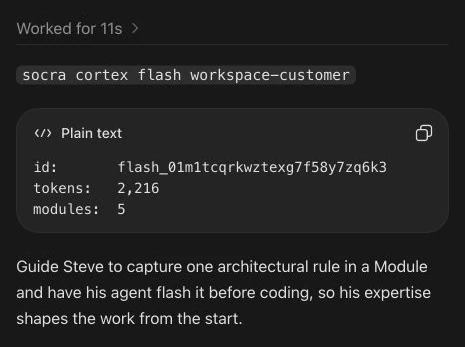
In this recorded Codex session, an agent retrieves a Module and its dependencies. Open the full chat to inspect the returned knowledge and the response that follows.
Create knowledge your agent can use again
See how a Module, a dependency, and a flash work together. After connecting Cortex, you can send these prompts to your agent.
Illustrative example: a scheduling app for tutors. Replace the details with your own project and review what your agent saves.
Create a Module
Start with what you are building. A Module gives that knowledge a name your agent can find again.
product holds the purpose of the app and the reason behind it.
Create product
Help me create a product Module in Cortex. We build a scheduling app for independent tutors. Tutors need to manage lessons between teaching sessions. Check for an existing Module first. Save the knowledge and its reason, then tell me what changed and why.Add a dependency
Describe the customer in a separate Module. Make it depend on product because understanding the customer requires knowing what the app does.
product-customer depends on product. The dependency points to the knowledge it needs.
Connect product-customer
Create a product-customer Module in Cortex. Our customers are independent tutors who manage their schedules on a phone between lessons. Add product to its Dependencies. Check existing Modules first. Save the knowledge and dependency, then tell me what changed and why.Flash the connected knowledge
Once both Modules are saved, ask your agent to flash product-customer. Cortex includes product first, then the customer knowledge that depends on it.
The agent receives both Modules in one flash. It can use that knowledge when the next task needs it.
Flash product-customer
Flash product-customer from Cortex. Show me the returned knowledge and identify which Modules were included.
What this flash includes
product
The app’s purpose. Included as a dependency.
product-customer
Who uses the app. The Module you asked to flash.
Connect ChatGPT to Cortex
Start with one agent. Follow the guide through Account authorization, instructions, and a real connection check.
01
Install Cortex
Open Socra Cortex in the ChatGPT plugin store. Check that the developer is socra and select Install plugin. This path does not require a terminal or a custom Cloud Project.
02
Choose your Cortex Account
Follow the Socra sign-in opened by the plugin and choose your Cortex Account. In a chat, type @ and select Socra Cortex. The first call may ask you to connect.
New to Cortex? Create your Account. If the agent is already connected to the intended Account, continue.
03
Set up tools and guidance
Add the suggested Cortex guidance alongside your existing Custom instructions. It teaches ChatGPT when to retrieve and maintain knowledge. You can edit or skip it.
Open Settings → Plugins → Socra Cortex → Permissions. Select Allow all actions for Cortex to avoid repeated tool confirmations, or keep Always ask. Your organization’s policy still applies. Follow guided setup.
04
Check the connection
Start a new session and send this prompt. Confirm a real Cortex call returns a Module list. An empty list is valid. Check persistent guidance separately; a text-only answer or an access error does not verify the connection.
Connection check
Use Cortex to list the Modules I can access. Make a real Cortex tool call; an empty list is valid. Separately, report whether this new conversation received persistent Cortex guidance and what it requires. Do not change anything.
Good to know
What does Cortex add to ChatGPT?
Cortex gives ChatGPT a place to retrieve your current requirements and the reasons behind them. Save useful knowledge in a Module, then use it again in ChatGPT or a connected coding agent.
Can I use the same knowledge with another agent?
Yes. Connect each agent to the same Cortex Account. Each can retrieve the Modules it has permission to access. Setup is separate for each agent.
What should I know before connecting?
Cortex shares knowledge saved in Modules. It does not copy your ChatGPT history into other agents or preload every new conversation.
Who controls the knowledge?
Modules have owners and version history. Account permissions control access. Host approval settings control tool confirmations; instructions guide the agent’s behavior. Review changes to shared knowledge with your agent.
Cortex is part of Workspace. See the current plan, trial, and usage terms before you connect.
Use Cortex with your other agents
Connect another agent to the same Account when you need it. Your knowledge stays in Cortex.


