
Stop Repeating Yourself to Your Agents
Cortex lets you and your team share context across your AI agents, giving each agent the right knowledge before it acts.


Use your agents exactly as you already do
Connect through Cortex plugins, MCP, or the Socra CLI.
- ChatGPT
- Claude
- Claude Code
- Codex
- Cursor
- GitHub Copilot
AI slop turns your life's work into a crime scene
You spent years learning how your systems really work. Then you handed them to agents that didn't.
Intelligence got cheap
Agents can touch more of your system now.
But they don't know your domain
The constraints, trade-offs, and hard-won reasons are missing from the context where agents act.
So they build the generic version
Not the one shaped by everything you know. Just the obvious one.
And your work erodes, one plausible edit at a time
Each change looks fine on its own. Together they wear away everything that made the work yours.
You're left reviewing AI slop and reverse-engineering damage to your own work. That is the crime scene.
Stop slop before the agent acts
Cortex gives agents your specific knowledge and its reasons before the work begins.
See the full technical mechanism
Context as Code gives agents your specific knowledge and its reasons before the work begins.
- 01
Capture what you know
Write a piece of your specific knowledge as a Module: a named, versioned specification of how one part of your system should work and why.
- 02
Connect what the agent needs
Declare what each Module depends on. Those relationships form a Semantic Directed Acyclic Graph (SemDAG). One flash assembles the named Module and its declared prerequisites, foundations first.
- 03
The agent starts with your standard
Before acting, the agent finds and flashes the narrowest relevant Module, bringing its prerequisite knowledge into the task.
- 04
The agent checks the current system
The agent reads your reasons, verifies the current code and runtime, and works against your standard. You review whether the result follows your system.
- 05
Your knowledge stays current
When work reveals useful knowledge, the agent updates the relevant Modules, preserves the reasons, and tells you what changed and why.
Your knowledge becomes the input. The agent checks the current system. You remain the source.
Agent Context Needs an Import Statement
Imagine your programming language of choice had no concept of an import statement. What would that mean for you as a developer?
- Mike Morton, Lead Software Developer
- 7 min read
The right work finds the right knowledge
An Issue says what must change. Its Module says what must remain true.
your inbox
released work
Recompute tax when the address changes
#418
checkoutReject expired promo codes in the cart
#392
pricingShow an ETA for partial shipments
#377
shippingIssues name the standard
Every Issue names its Module. The agent or teammate who picks it up can flash that Module before work starts.
Dependencies protect the sequence
Issues declare dependencies on other Issues, forming a directed graph of work. The inbox releases an Issue after all its dependencies close.
Only ready work reaches you
The inbox shows released, unclosed work assigned to you. It also shows untriaged work in modules you own.
Ready work reaches its owner with dependencies clear and the standard the agent must preserve.
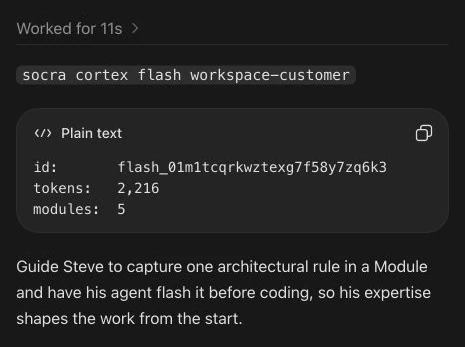
See Cortex in a real chat
An agent flashes workspace-customer, then uses what it learns to suggest how Steve should get started.
Stored once, served on demand
Your Modules live in the cloud as one graph: stored in your Workspace, addressed by name, and owned by you. Any authorized team member or agent can flash the same source from a connected tool.
Addressed, not filed
A module is referenced by name from repositories and tools connected through Cortex.
Yours to share
The Account boundary isolates its people, installed agents, and Modules from every other Account.
Owned, not orphaned
Every module has a human owner who is accountable for its content.
From you to your whole org
Start alone and add members when needed. The Account boundary keeps each organization isolated.
One Account boundary
An Account is the tenant, billing, and isolation boundary for its people, installed agents, and Modules.
One account-scoped graph
People and installed agents work from the same account-scoped graph.
Supports a growing team
The same Account model supports a developer working alone and organizations with many members.
Account
acme-platform

you
Owner
Dana
Member
Priya
MemberChatGPT
Installed app
Account boundary · isolated tenant
Your standard compounds instead of eroding
Every future flash that uses your standard carries it forward.
Your work can compound when each change starts from the applicable standard and you verify the result.
Be the source again
Create your Account. We’ll guide you through connecting your first agent.